AI TOOL / #07115
DocXter
AI tools that extract insights from documents, generate questions, and simplify language.
Introduction
AI tool to extract insights from documents, ask questions, and simplify language.
What is DocXter?
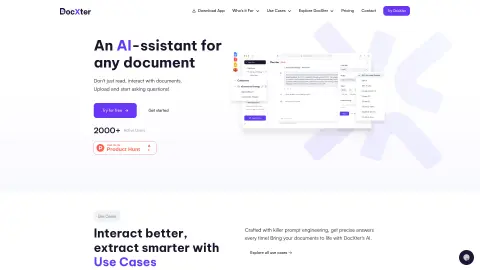
DocXter is an intelligent AI tool designed to extract valuable insights from any document. Users can upload documents, pose questions, simplify the content, and interact with these documents. It is aimed at enterprises, teams, professionals, and legal entities, offering features such as AI agents, knowledge bases, access to AI models, and OCR technology – all of which help transform paper documents into actionable information.
How to use DocXter?
Upload the document to DocXter, and then use the AI assistant to ask questions, simplify the text, analyze its content, or perform other tasks as needed.
The core functions of DocXter
An AI agent equipped with task-specific assistance capabilities
A knowledge base used for organizing and managing knowledge.
Access the latest AI models.
The OCR function converts paper documents into usable information.
Real-time collaboration
Multi-document analysis
A knowledge base used for organizing and managing knowledge.
Access the latest AI models.
The OCR function converts paper documents into usable information.
Real-time collaboration
Multi-document analysis
Related
Krut AI
An AI platform for generating custom e-commerce images, no professional tips required.
Sivi AI
Multilingual AI design generator for rapid graphic design creation and editing.
AI Thriving
AI-powered image generation API for text and image conversion.
Neural Canvas
An AI-based generator for digital illustrations and comics.
Voz AI Voice Note Taker
An AI-based note-taking tool used for recording, transcribing, and summarizing audio and video content.
ArXiv Insight: Paper Summarizer
ArXiv Insight is an artificial intelligence-powered extension that enables the conversion of complex ArXiv research papers into concise summaries. It provides key insights in just a few seconds, focusing on the paper’s main objectives, contributions, key findings, and conclusions.